University of Cyberjaya (UoC) defines sustainability as a term that encompasses all aspects of ethical business practices by addressing relevant issues responsibly and profitably.
The University recognises the importance of sustainability and its increasing impact to our operations. We are committed to understanding and implementing sustainable practices and to exploring the benefits to the University whilst attempting to achieve the right balance between the needs of the wider community and our focus on delivering quality education to our students.
How the University of Cyberjaya meets THE Impact Rankings indicator 4.3
· Data year 2025
A university's responsibility for education does not end at the campus gate. The University of Cyberjaya opens its library and learning resources to the public, hosts free lectures and workshops, runs short courses and training for working professionals, and sends its students and staff into schools, children's homes and community centres to teach.
This page explains, question by question, how the University meets the five parts of THE Impact Rankings indicator 4.3, Lifelong learning measures. For each question we set out what we do, how it meets the question's objective, and the programmes behind it. Each initiative links to the SDG Impact Report where it is described in full.
1,600+
pupils and learners reached by outreach beyond campus
9
schools reached through education outreach
298
people at free public lectures and workshops on campus
RM1.7m
from short courses and training for professionals in 2025
How to read this page: Each section quotes THE’s question, gives our answer, explains how our work meets it, and summarises the initiatives behind it. “Read more” points to the page of the SDG Impact Report where each initiative is described in full.
4.3.1 Free Access to Educational Resources
THE QUESTION
Does your university as a body provide free access to educational resources for those not studying at the university, e.g. computers, library, online courses, access to lectures, etc?
OUR ANSWER
Yes. Members of the public can use the University library, its computers and Wi-Fi free of charge, and the University publishes free online learning guides and recordings of its public lectures. It has also created learning resources that stay with the communities it works in, such as the EduHub learning centre at SMK Seri Sepang.
How we meet this question
The University library is open to members of the public for reference use free of charge, including access to its computers and Wi-Fi. Recordings of public lectures and talks are posted free online on the University's channels, so that people who could not attend can still learn from them, and open-access learning guides are published online, such as the one-page guide on early childhood development produced after the MAPSA 2025 session for parents and preschool teachers.
The University also builds learning resources into the communities it serves. Between May and October 2025, student volunteers turned an unused school library into EduHub, a holistic learning centre for the 850 students of SMK Seri Sepang, with a Smart Corner of tablets, re-catalogued books and career-pathway displays. Outreach teams routinely leave teaching kits behind, from a Bahasa Melayu papermaking lesson kit at SK Orang Asli Bukit Tadom to lesson slides and first-aid kits, so that teachers and carers can repeat the learning.
4.3.2 Public Lectures and Community Education Events
THE QUESTION
Does your university as a body host events at university that are open to the general public: public lectures, community educational events?
OUR ANSWER
Yes. In 2025 the University hosted free public lectures, workshops and community education events on campus, including Access to Quality Education, the MAPSA early childhood session, the Climate Fresk workshop and the Medical Device Authority's awareness programme.
How we meet this question
The University's public events are free and open to anyone. On 9 June 2025, 'Access to Quality Education' brought 40 schoolteachers, NGO tutors, parents and students from Cyberjaya, Putrajaya and Dengkil together to examine why some learners are left behind and how lessons can be made more inclusive. On 10 May 2025, the University hosted the Malaysian Psychology Students Assembly (MAPSA), whose session on early childhood development was opened to local parents and preschool teachers free of charge.
During SDG Week in December 2025, the University hosted a Climate Fresk workshop for 160 participants, including teachers and pupils from two Cyberjaya secondary schools. On 7 October 2025, it hosted the Medical Device Authority's Medical Device Awareness Programme in its Grand Hall for about 180 students, staff and industry representatives. Faculty members also take public lectures into community spaces, such as a mental-health talk for shoppers at AEON Cheras Selatan.
Public lectures and community education events on campus, 2025
Event
Date
Participants
MAPSA 2025: Exploring the Diversity of Early Childhood Development
10 May
34, including 11 parents and preschool teachers
Access to Quality Education
9 June
40 teachers, NGO tutors, parents and students
Medical Device Awareness Programme, with the Medical Device Authority
7 October
About 180
Climate Fresk workshop, SDG Week
10 December
160, including 18 school guests
Sustainable Business Enterprise Workshop, SDG Week
Does your university as an educational body host events at university that are open to the general public: executive education programmes (this refers to short courses for people who are not attending the university; this specifically excludes courses like MBA) and/or vocational training?
OUR ANSWER
Yes. The University runs short courses, seminars and training for working professionals, which generated RM 1,706,732 in 2025, and free skills workshops for the public, including the four-day Engineering Better Care course for 42 health professionals.
How we meet this question
Executive education: the University's faculties deliver short courses, seminars and knowledge-sharing programmes for people who are not University students, from short clinical and health-sciences courses to management and technology seminars, on campus and at clients' premises. These programmes generated RM 1,706,732 in 2025. From 22 to 25 September 2025, the Centre of Biomedical Engineering co-hosted Engineering Better Care with Advance Pact (UK) and the Centre for Systems in Health Malaysia, a four-day course in which 42 professionals from six hospitals and health organisations learned to apply systems engineering to their own services.
Vocational training: the University also runs free practical skills workshops open to the public. The Sustainable Business Enterprise Workshop on 8 December 2025 taught 64 participants how to build businesses that meet social and environmental needs, led with the founder of a social enterprise that employs B40 women. Pharmacy students trained 55 children and six caregivers at a children's home in first aid and CPR.
Short courses and training for non-students, 2025
Programme
Type
Participants
Short courses, seminars and knowledge-sharing programmes
Executive education (fee-paying)
Working professionals; RM 1,706,732 income
Engineering Better Care (22–25 September)
Executive education
42 professionals from six health organisations
Sustainable Business Enterprise Workshop (8 December)
Does your university as a body undertake educational outreach activities (e.g. tailored lectures or demonstrations) beyond campus, e.g. in local schools, in the community, including voluntary student-run schemes?
OUR ANSWER
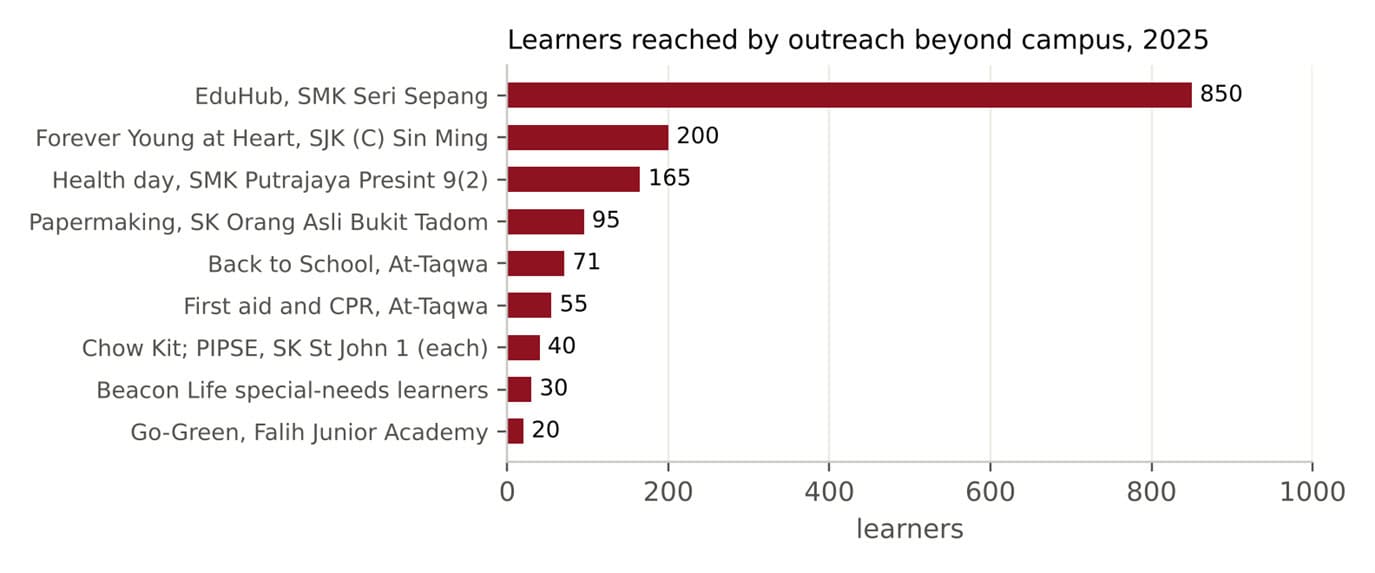
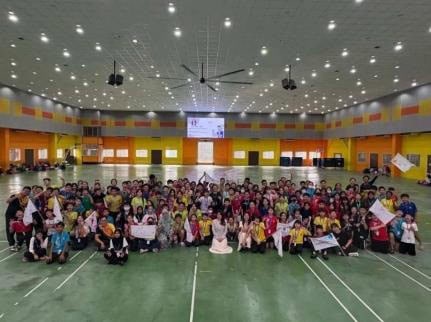
Yes. In 2025 University students and staff taught in 9 schools and in children's homes and community centres, reaching more than 1,600 pupils and learners, much of it through student-run schemes built into the curriculum.
How we meet this question
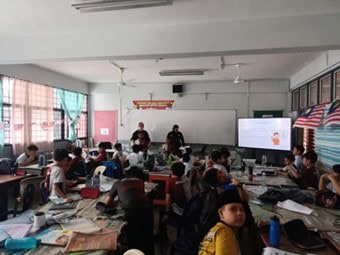
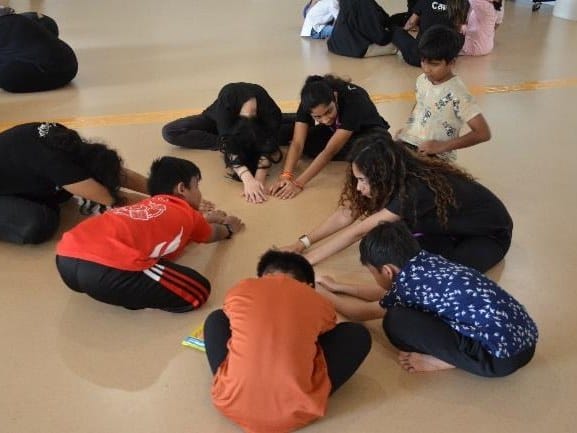
Educational outreach is built into the University's courses. Students on the Environmental Volunteerism and Young Mercy courses, psychology students and medical students design and deliver tailored lessons, demonstrations and programmes in schools and communities, supervised by their lecturers, and student clubs run longer projects such as EduHub at SMK Seri Sepang.
In 2025 this outreach reached primary and secondary schools, including an Orang Asli school and a special-education class, as well as children's homes, a learning centre for children with special needs and a foundation for underserved children in Chow Kit. Many programmes measure what pupils learned: in the Go-Green lesson, the class quiz average doubled from 4 to 8 out of 10, and after the transition camp at SJK (C) Sin Ming, the share of pupils worried about secondary school fell from 58% to 31%.
Educational outreach beyond campus, 2025
Programme
Where
Learners
Forever Young at Heart transition camp
SJK (C) Sin Ming
200 Standard 6 pupils
Go-Green climate and recycling lesson
Falih Junior International Academy, Cyberjaya
20 pupils aged 8 to 10
Pencils from Paper
SK Orang Asli Bukit Tadom, Banting
95 Orang Asli pupils
EduHub learning centre
SMK Seri Sepang
850 students
Health and careers day
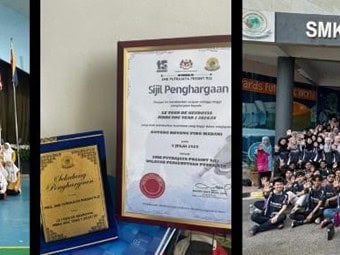
SMK Putrajaya Presint 9(2)
165 students, including a special-education class
Hati Kuat, Kawan Selamat
SAR Kafai, Taman Melawati
70 pupils
PIPSE emotional development programme, with USM
SK St John 1, Kuala Lumpur
40 pupils
Safe Spaces
Yayasan Chow Kit, Kuala Lumpur
40 children
Inclusive learning visit
Beacon Life Training Centre
30 learners with special needs
Back to School, and first aid and CPR
Rumah Kebajikan dan Bimbingan At-Taqwa, Puchong
71 asnaf children and caregivers; 55 children
Learners reached by each outreach programme beyond campus in 2025.
Does your university as a body have a policy that ensures that access to these activities is accessible to all, regardless of ethnicity, religion, disability, immigration status or gender?
OUR ANSWER
Yes. The Cyberjaya Education Group Berhad Code of Conduct, section 7.2, and the University's Lifelong Learning Policy prohibit discrimination and guarantee open access to the University's public lectures, short courses and other learning activities, whether free or fee-paying.
How we meet this question
The University of Cyberjaya is part of Cyberjaya Education Group Berhad (CEGB), whose Code of Conduct sets out the core values that apply to all of its institutions. Section 7.2 of the Code, on Diversity and Inclusion, prohibits discrimination on the grounds of gender, race, religion, age, sexual orientation, disability or any other characteristic protected by law, in every part of the Group's business. This applies to students and to members of the public who take part in or enrol in any of the University's educational activities, whether free or fee-paying.
The University's Lifelong Learning Policy applies the same principle to its public learning activities, guaranteeing open access to public lectures, community education and short courses regardless of age, gender, ethnicity, religion, disability or background.
In practice, the University's learning activities reach people of every background: Orang Asli pupils, children with special needs, asnaf families and refugee communities, including Rohingya and Myanmar refugees reached through its health and mental-health education programmes. Public lectures and workshops on campus are free to attend.
Policies that guarantee accessPoli
Policy
Scope
CEGB Code of Conduct, section 7.2: Diversity and Inclusion
All CEGB institutions; prohibits discrimination on the grounds of gender, race, religion, age, sexual orientation, disability or any other characteristic protected by law
University of Cyberjaya Lifelong Learning Policy
Open access to public lectures, community education and short courses regardless of age, gender, ethnicity, religion, disability or background